
How to Find Your Buick’s Original Paint Color and Paint Code
Search Window Sticker
Table of Contents
Key Takeaways
- Find the paint code on your Buick’s factory label, often marked BC/CC or with a GM paint code.
- Use the VIN as backup to locate factory records and view the exterior and interior colors, especially when the paint label is missing.
- Verify the original color with RPO data, window stickers, build sheets, and signs of repainting.
Need to touch up a scratch, replace a damaged body panel, or restore an older Buick? Knowing the Buick paint code can help you choose the correct factory color instead of relying on a photo or a general color name.
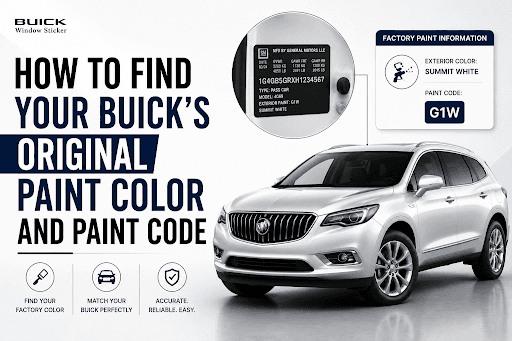
The paint code identifies the factory color specification for your Buick. You can often find it on the vehicle's Service Parts Identification (SPID) label or another factory label. On many newer GM vehicles, paint information is also available through the QR code on the certification label.
If the label is missing or unreadable, the VIN can still be useful. It can help to generate a window sticker showing the vehicle’s original interior and exterior color.
Why Your Buick’s Paint Code Matters
Your Buick's current color isn't always the same color it had when it left the factory. A previous owner may have repainted the vehicle, repaired individual panels, or changed the color completely.
The factory paint code gives you a better starting point when you need to:
 Order matching touch-up paint
- Repair scratches and chips
- Repaint a damaged panel
- Match a replacement body panel
- Restore a classic Buick
- Verify the original factory color
- Document a rare or unusual color
- Determine if the Buick has been repainted
If you're restoring a collector Buick, the original color can also be an important part of establishing how the car was built.

Important: Your VIN identifies the vehicle, but the complete paint code usually comes from the factory label, RPO data, build records, or original documentation rather than the visible VIN characters themselves.
Paint Color vs. Paint Code vs. Trim Code
These terms can sound interchangeable, but they refer to different things.
Term | What It Means | Example |
Paint color | The name of the factory exterior color | Ebony Twilight Metallic |
Paint code | The manufacturer's code identifying the color | WA#### or GM color code |
RPO code | A GM code identifying factory equipment | Three-character production code |
Interior trim code | Identifies interior color and materials | Interior upholstery or trim code |
VIN | Unique identifier for the vehicle | 17-character VIN |
Color match | Paint prepared to match the original finish | Repair or repaint formula |
GM paint labels commonly use formats such as BC/CC, which refers to base coat/clear coat. Depending on the Buick, you may also see a code beginning with WA, U, or another GM paint-code format.
The paint code is what you need when ordering paint. The color name is useful for identifying the shade, but two colors with similar names can have completely different formulas.
Start With the VIN, But Know Its Limits
Your Buick's VIN is still an important part of the process because it identifies the specific vehicle.
What the VIN Can Help With
A VIN can help you:
- Confirm the Buick model
- Confirm the model year
- Match factory records to the vehicle
- Support a search for build information
- Find an original window sticker with the original factory colors
- Help a dealer locate vehicle-specific information
What the VIN Usually Does Not Show Directly
The 17 characters of the VIN generally won't spell out the complete paint color in plain English.
A VIN alone also cannot tell you:
- If the Buick has been repainted
- If a body panel was replaced
- If the current color matches the factory color
- The complete paint and trim combination
- The exact paint formula needed for a repair
That's why it's better to think of the VIN as a way to identify the vehicle and locate supporting records, rather than as the paint code itself.
Use the VIN to identify the Buick. Use the paint label, RPO information, or factory records to confirm its original color.
How to Find Your Buick’s Original Color by VIN
You can use your Buick’s VIN to retrieve its original window sticker. The sticker clearly lists the factory exterior and interior colors for your specific vehicle. The simple steps to follow are:
- 1
Enter Your VIN
Enter your Buick’s VIN into the window sticker lookup tool. - 2
Get the Window Sticker
Retrieve the original factory window sticker linked to your VIN. - 3
Check the Exterior Color
Find the factory exterior color listed on the sticker. - 4
Check the Interior Color
See the original interior color and trim information.
Where to Find the Buick Paint Code
The location of the paint code varies by Buick model and model year. GM has used Service Parts Identification labels in different locations, while newer vehicles can provide much of this information through a QR code on the certification label.
Here are the main places to check.
Check the Driver-Side Door Jamb
Open the driver's door and inspect the area around the door opening.
Look around:
- The B-pillar
- Door frame
- Door edge
- Certification label
- Nearby vehicle-information labels
On newer GM vehicles, the certification label is located on the driver's-side B-pillar, and beginning with the 2018 model year, GM added a QR code containing VIN, RPO, and paint information to Buick and other GM vehicles.
Check the Glove Compartment
If you don't see the information around the driver's door, check inside the glovebox.
Older GM vehicles commonly used a Service Parts Identification (SPID) label that could be located in the glovebox.
Look for a label containing a long list of three-character codes. The paint information may appear alongside the other vehicle configuration data.
Check the Trunk and Spare-Tire Area
Older Buicks may have the SPID label in the trunk or around the spare-tire compartment.
Check:
- Trunk floor
- Spare-tire cover
- Spare-tire well
- Inside the trunk lid
- Side trunk panels
- Rear cargo floor
This location has been reported on several older Buick models, although the exact location depends on the vehicle.
Check Under the Hood
Some vehicles may have additional identification information around the engine compartment.
Check areas such as:
- Radiator support
- Firewall
- Inner fender
- Strut tower
- Underhood labels
- Body identification plates
Don't assume every label under the hood contains paint information. Emissions labels, tire-pressure information, battery labels, and service stickers are different from the factory paint or RPO label.
How to Read a Buick Paint Code Label
Once you find the correct label, you may see several codes that look almost identical. The key is finding the line associated with the exterior paint.
Common Paint-Code Terms
Label Term | What It May Indicate |
BC/CC | Base coat/clear coat |
WA#### | GM paint/color reference |
U#### | Upper or body color on applicable labels |
L#### | Lower or secondary color on applicable labels |
RPO codes | Factory-installed equipment and configuration |
QR code | Digital vehicle configuration information on applicable newer models |
Buick paint-code references commonly appear next to BC/CC, and two-tone vehicles can have separate upper and lower color codes.
Example of a Paint Code
You might see something similar to:
BC/CC U8554
In this example:
- BC/CC refers to the base coat/clear coat system.
- U8554 is the paint-code reference.
- The color's marketing name may not be printed on the label.
- The code can be matched against a GM/Buick paint database or supplied to a paint professional.
The exact format varies by model and year, so use the code actually shown on your Buick rather than trying to match it to a generic example.
What About a Two-Tone Buick?
A two-tone vehicle may show separate codes for different parts of the exterior.
For example:
BC/CC U1234 / L5678
The U entry can identify the upper or main body color, while the L entry can identify a lower, secondary, or bumper color on applicable GM labels. The exact meaning depends on the vehicle and paint scheme.
Find the Original Color Through RPO Codes
Buick uses Regular Production Option (RPO) codes to identify factory-installed equipment and vehicle configuration.
A Buick's RPO information can include codes related to:
- Exterior color
- Interior trim
- Engine
- Transmission
- Suspension
- Wheels
- Safety equipment
- Technology
- Appearance packages
- Other factory-installed equipment
Older GM vehicles commonly had these codes printed on a Service Parts Identification label. Starting with the 2018 model year, much of this information moved to a QR code on the certification label.
How Paint Appears in RPO Data
Depending on the Buick, factory information may help identify:
- Exterior color
- Two-tone paint
- Roof color
- Accent color
- Special appearance equipment
- Other paint-related production information
Don't try to decode an RPO code using a random list without checking the correct model year. Codes need to be interpreted against the appropriate GM vehicle information.
Use Factory Documents to Confirm Original Paint
A paint label is useful, but original documentation can provide another layer of confirmation.
Document | What It Can Help Confirm |
Original window sticker | Original window sticker |
Dealer invoice | Ordered equipment, color, and pricing |
Build sheet | Factory configuration and production information |
RPO/SPID label | Paint and factory equipment codes |
Body/cowl tag | Paint and trim information on many classic Buicks |
Factory brochure | Colors offered for a particular model year |
Restoration records | Previous paintwork and repairs |
For a classic or valuable Buick, try to match the documentation to the VIN, model year, body style, and production information. A loose document without a VIN or other identifying information shouldn't automatically be treated as proof that it belongs to the car.
How to Tell if Your Buick Was Repainted
Finding the factory paint code tells you what color the Buick was supposed to have when it was built. It doesn't prove the paint on the vehicle today is original.
Look for signs such as:
Different Colors in Protected Areas
Check behind trim, inside door jambs, under the hood, inside the trunk, and other areas that may not have been repainted.
Overspray
Paint on weatherstripping, wiring, glass, trim, or other components can indicate that a vehicle was painted after leaving the factory.
Different Shades Between Panels
A door, fender, hood, or bumper that looks noticeably different from adjacent panels may have been repaired or replaced.
Missing Factory Labels or Decals
Paintwork can cover, remove, or damage original labels and markings.
Previous Repair Records
Invoices or insurance records showing collision repairs or a repaint can help explain differences between the factory color and the current finish.
A repaint isn't automatically a bad thing. A well-done repaint in the original factory color can still look excellent. The important thing is knowing what you're looking at.
Why the Correct Paint Code May Still Look Different
Even with the correct factory code, fresh paint may not look exactly like an older Buick's current finish.
Paint can change over time because of:
- Sun exposure
- Weather
- Oxidation
- Previous polishing
- Earlier repairs
- Different paint batches
- Aging clear coat
- Different materials between metal and plastic panels
Metallic and pearl finishes can be especially difficult to match visually.
For an important repair, give the factory paint code to a professional automotive paint supplier or body shop. A spray-out test or professional color-matching process can help determine how the new paint will look next to the existing finish.
Special Considerations for Classic Buicks
Finding the original color can be more involved when you're working with an older Buick.
Classic Buicks may rely on several pieces of evidence rather than a single modern label.
Look for:
- VIN and VIN-series information
- Body or cowl tag
- Original build sheet
- Dealer invoice
- Original sales paperwork
- Period Buick color charts
- Factory brochures
- Original warranty documents
- Surviving factory labels
- Restoration records
Check for Original Paint in Protected Areas
Even if a classic Buick has been repainted, small areas of original paint may survive.
Check:
- Behind door panels
- Under weatherstripping
- Behind emblems
- Under carpeting
- Inside the trunk
- Under the rear seat
- Behind interior trim
- Around hinges
- Inside the engine compartment
These areas can help you compare the vehicle's current color with its original finish.
However, surviving paint should be treated as supporting evidence, not proof by itself. The strongest conclusion comes from matching the surviving paint with factory codes and documentation.
Rare and Two-Tone Buick Colors
Special-order colors, limited-production models, and two-tone combinations can be harder to identify using basic online color charts.
If you're dealing with a rare Buick, use the VIN, factory documentation, period color charts, and knowledgeable Buick restoration resources together.
What If Your Buick Paint Label Is Missing?
Don't assume you're stuck.
Try this process:
- 1.Confirm the VIN from the vehicle and paperwork.
- 2.Search the driver's door area.
- 3.Check the glovebox.
- 4.Inspect the trunk and spare-tire area.
- 5.Look for the RPO/SPID label.
- 6.Check for a QR code on applicable newer Buicks.
- 7.Search for an original window sticker.
- 8.Look for a dealer invoice or build sheet.
- 9.Ask a Buick dealer if factory information is available.
- 10.Compare the vehicle with the correct model-year color information.
- 11.Inspect protected areas for surviving original paint.
- 12.Have a paint professional verify the code before ordering paint.
What Not to Do
Don't order paint based only on:
- A photograph
- A seller's description
- A generic color name
- The color currently visible on the car
- A random online color chart
- A paint scanner alone
A paint scanner can help match the current finish, but it doesn't prove that the current finish is the original factory color.
Find Your Buick’s Original Factory Color
The easiest place to start is your Buick's factory paint label. Look for the BC/CC information or another paint-code reference, then match that code with the correct Buick model-year data.
If the label is missing, your VIN can help you track down factory information and documentation. For a classic Buick or a vehicle with questionable paint history, compare several sources before deciding what the original color was.
Need to confirm your Buick's original color? Use the VIN to check available factory information and paint details.