
Buick VIN Decoder Explained: What Every Character Means
Search Window Sticker
Table of Contents
Key Takeaways
- A Buick VIN decoder translates your 17-character VIN into clear, useful vehicle details.
- Every character has an exact meaning, from the country of origin down to the production sequence.
- Checking the VIN helps confirm key specs like the model year, engine family, and assembly plant.
- Decoding the number comes in super handy whether you're buying, selling, insuring, or maintaining a Buick.
A Buick VIN decoder is easily one of the quickest ways to learn more about a car before you buy it, sell it, or start ordering replacement parts. At first glance, the VIN just looks like a random, confusing mix of letters and numbers. Yet in reality, every single character serves a specific purpose.
The 17-character VIN tells you the basics, like the manufacturer, model year, engine family, assembly plant, and other factory details. When you type it into a lookup tool, those characters get translated into clear information that’s way easier to understand. Modern Buick VINs follow the standardized 17-character format adopted back in 1981, with each spot representing exact vehicle specs.
So instead of guessing off general listings about what trim or engine a Buick has, you can use the VIN to verify the original factory specifications in just a few seconds.
What Is a Buick VIN?
A Buick VIN (Vehicle Identification Number) is basically a unique 17-character fingerprint for your vehicle. No two cars on the road share the exact same sequence.
Since 1981, automakers have stuck to a standardized VIN setup, which makes it easy to track and identify vehicles across different brands using the exact same basic structure.
Besides identifying the car, the VIN ties everything together. It connects your vehicle to its factory build records, title registration, insurance coverage, and service history.
You’ll usually need the VIN when you're:
 Looking up factory specs
- Ordering exact replacement parts
- Checking original warranty info
- Generating a copy of the window sticker
- Shopping for or selling a used Buick
Basically, whenever you need accurate info on a Buick, the VIN is the best place to start.
Where Can You Find Your Buick VIN?
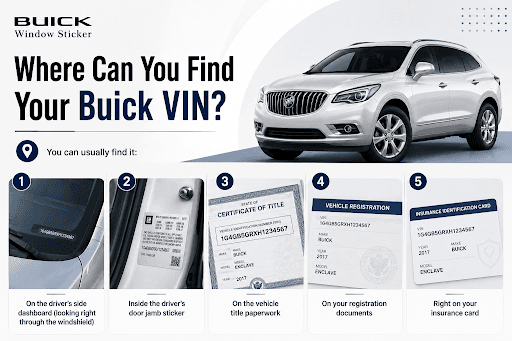
Before you run a lookup, you’ll need to grab the VIN first. Fortunately, Buick puts it in a few easy-to-spot locations around the car and on your paperwork.
You can usually find it:
- 1.On the driver's side dashboard (looking right through the windshield)
- 2.Inside the driver's door jamb sticker
- 3.On the vehicle title paperwork
- 4.On your registration documents
- 5.Right on your insurance card
If you’re checking out a used Buick, it’s always a smart move to compare the VIN in more than one spot. All the characters should match up exactly. If they don't, that's your sign to pause and investigate further.
How to Decode the 17 Characters in a Buick VIN?
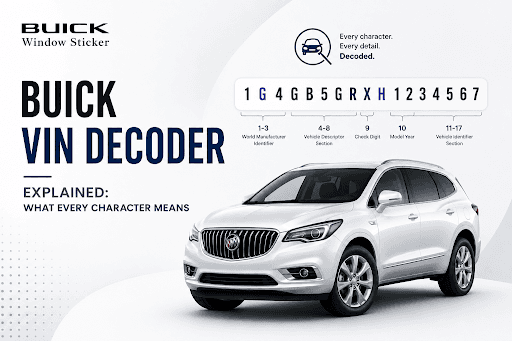
The VIN isn't just one continuous block of text. It’s actually split into three main sections, and each one reveals something different about how the vehicle was built. These sections are known in the industry as the WMI, VDS, and VIS.
Here is how those 17 characters break down.
How the 17 Characters Are Organized?
Every modern Buick VIN tool decodes the string using the same baseline rules. The 17 characters break down into three distinct groups, with each piece giving you another layer of vehicle specs. While a few details vary depending on the model and year, the overarching structure stays identical across all modern Buicks.
Let's break it down section by section.
Characters 1–3: World Manufacturer Identifier (WMI)
The first three characters tell you who built the vehicle and where the VIN series was registered.
Character 1: Country of Origin
The very first character identifies the country tied to the automaker. Common Buick examples include:
- 1, 4, or 5 = United States
- 2 = Canada
- 3 = Mexico
- K = South Korea
- L = China
This doesn't always mean the car was physically put together there, but it pinpoints the country registered to that manufacturer code.
Character 2: Manufacturer
The second spot identifies the manufacturer itself. Since Buick lives under the General Motors umbrella, this character distinguishes GM builds from other automakers.
Character 3: Vehicle Division
The third spot identifies the specific Buick division or vehicle type within General Motors. Together, this trio forms the World Manufacturer Identifier (WMI). It’s the first thing the decoder reads before tackling the rest of the sequence.
Characters 4–8: Vehicle Descriptor Section (VDS)
This is the part where the VIN starts getting really interesting. Characters 4 through 8 describe the actual physical build of the vehicle. Depending on the specific model and year, they identify details like:
- Model or series line
- Body style
- Engine family
- Safety restraint setup
- Drive configuration
Just keep in mind that these characters don't always mean the exact same thing from one Buick to the next. GM shifts these internal codes around based on the vehicle line and production year, which is why typing the code into a lookup tool is way easier than memorizing code books.
Character 9: The Check Digit
The ninth spot isn't about features, paint, or engines at all. Instead, it’s a mathematical security check used to authenticate the VIN.
If a VIN is typed in wrong, the check digit catches the math error right away. That keeps typos from messing up title registrations, insurance policies, or dealership service orders. Think of it as a built-in quality control check for the number itself.
Character 10: Model Year
The tenth character tells you the vehicle's model year. This is easily one of the most frequently decoded spots because shoppers want quick proof that the advertised year matches the factory record.
Some common codes are:
Code | Year | Code | Year | Code | Year | Code | Year |
Y | 2000 | A | 2010 | L | 2020 | A | 2030 |
1 | 2001 | B | 2011 | M | 2021 | B | 2031 |
2 | 2002 | C | 2012 | N | 2022 | C | 2032 |
3 | 2003 | D | 2013 | P | 2023 | D | 2033 |
4 | 2004 | E | 2014 | R | 2024 | E | 2034 |
5 | 2005 | F | 2015 | S | 2025 | F | 2035 |
6 | 2006 | G | 2016 | T | 2026 | G | 2036 |
7 | 2007 | H | 2017 | V | 2027 | H | 2037 |
8 | 2008 | J | 2018 | W | 2028 | J | 2038 |
9 | 2009 | K | 2019 | X | 2029 | K | 2039 |
It’s worth noting that the model year doesn't always match the calendar build date. For example, a 2026 Buick model might have rolled off the assembly line in late 2025. The decoder translates the letter or number code into the actual model year automatically so you don't have to keep track of chart lists.
Character 11: Assembly Plant
The eleventh character identifies the exact factory plant where the Buick got assembled.
Plenty of owners just like knowing where their car was built, while collectors use it to document a classic's history. On its own, the plant code doesn't change how the car drives, but it’s a cool piece of the build story.
Characters 12–17: Production Sequence Number
The final six digits make up the vehicle's unique production sequence number. This is what separates your Buick from every single other Buick built with identical specs.
Even if two cars have the exact same trim, paint, options, and engine, these last six digits will always be different. Combined with the rest of the VIN, they create that unique fingerprint used throughout the car's life for title history, warranty coverage, recalls, and maintenance records.
What Can a Buick VIN Decoder Tell You?
A proper decoder gives you way more than just the basic make and model. By breaking down those 17 characters, it translates raw factory codes into simple, readable facts.
Depending on the car and available factory databases, a VIN lookup confirms:
- Model year
- Make and model
- Engine specs
- Transmission setup
- Body style
- Drivetrain (FWD, AWD, etc.)
Our lookup tools even tie the VIN back to broader factory records, letting you view specs, warranty setup, a reproduced original window sticker, and even vehicle history reports. Basically, it’s a fast way to confirm you’re dealing with the right car before spending your money.
What a VIN Decoder Can't Tell You?
A lot of people assume the VIN holds every tiny detail about a vehicle, but that’s not quite how it works. While it carries tons of baseline data, some details simply aren't baked into those 17 characters.
For example, a standard VIN decoder won't show you:
- Every tiny factory-installed option
- Optional equipment packages (like tow gear or appearance packages)
- Interior and exterior paint codes
- Dealer-installed accessories
- Current vehicle condition
- Accident or title history
That’s where paperwork like the original window sticker or factory build sheet comes into play. They fill in those blank spots by listing all the smaller options and packages that the VIN skips over.
When Should You Decode a Buick VIN?
Running a lookup isn't just for mechanics or dealerships. It comes in handy anytime you need quick clarity on a Buick's specs.
Here are a few common scenarios:
Shopping for a Used Buick
Before buying a used car, run the VIN to verify that the advertised year, engine, and trim actually match factory records. It takes a few seconds and helps catch bad listings or vague claims before they become your problem.
Selling Your Buick
Handing prospective buyers accurate details builds trust fast. Decoding the VIN makes it super easy to write a spot-on listing and answer questions about original specs with confidence.
Ordering Replacement Parts
Buick parts often change based on the engine family, drivetrain, or mid-year production tweaks. Using the VIN ensures you order components that actually fit your specific car the first time.
Hunting Down Factory Papers
Many owners use the VIN to pull up original vehicle documents, including:
- Original window sticker copies
- Factory build sheets
- Original warranty terms
- Exact paint and trim codes
Buick VIN Decoder vs. Window Sticker
People mix these two up all the time, but they serve completely different purposes.
A Buick VIN decoder focuses purely on the standardized info embedded within the 17 digits. It’s great for verifying the baseline vehicle identity and core engine specs.
A window sticker goes way further. It gives you the total picture, including:
- Starting MSRP and total price
- Full standard equipment list
- Itemized optional packages
- EPA fuel economy ratings
- Factory warranty details
- Government safety ratings
- Destination charges
The simplest way to think about it: the VIN decoder identifies the vehicle, while the window sticker shows you every single feature and option assigned to that car at the plant.
Now You Know How to Decode Your Buick VIN
A Buick VIN decoder is easily one of the fastest tools for making sense of a vehicle's identity. By understanding how each character works, you can verify the model year, engine, plant, and core specs in just a couple of minutes.
Just keep in mind that the VIN only tells part of the story. If you need to confirm small option packages, original MSRP, or exact paint codes, pairing your VIN check with an original window sticker or build sheet gives you the total view of how your Buick left the factory floor.